Window tint meters help auto shops, film installers, and DIY enthusiasts verify transmittance, UV rejection, and infrared rejection of glass and films. Selecting the right meter supports legal tint compliance, consistent quality control, and reliable inspections. This guide spotlights five top window tint meters, chosen for accuracy, ease of use, and durability—from portable handheld models to bench-top testers with data locking and automatic calibration. Use the summary table to compare core specs at a glance, then explore each model’s strengths in dedicated sections.
| Product | Brand | Key Feature |
|---|---|---|
| Digital Tint Meter TM-26 | VVV-Group | 8 mm slot; UVR/IRR; demonstration-ready |
| Enforcer II Tint Meter | Laser Labs | NIST-traceable; USA-assembled; Battery included |
| Mxmoonfree Tint Meter | Mxmoonfree | 3-in-1 readings; 8 mm slot; Roll-Down Windows Only |
| GOYOJO Labs Tint Meter | GOYOJO | 3-in-1 VL/UV/IR; Data lock; 8 mm slot |
| Landtek Window Tint Meter | Landtek | Auto-rotating display; 3 display modes |
Digital Tint Meter TM-26

The TM-26 is designed for car side windows and solar films, delivering quick, repeatable readings of light transmittance and rejection of ultraviolet and infrared radiation. It supports testing glass and film up to 8 mm (1/3 inch) thick, making it suitable for typical automotive glass and aftermarket tint samples. Measurements are recorded with a simple control, facilitating straightforward documentation during inspections or demonstrations.
- Measures visible light transmittance (VLT), UV rejection, and IR rejection
- Suitable for glass and film up to 8 mm thick
- One-button operation for fast results
- Compact design with PU case included
- Applicable as an educational demo for solar films
Enforcer II Tint Meter

The Enforcer II emphasizes reliability and traceability. It is assembled in the USA and provides NIST-traceable results, with a battery included for portable, on-site use. This model is designed for shops that require documented accuracy and easy field testing, making it a solid choice for quick inspections and quality control workflows.
- Assembled in the USA
- Traceable to NIST standards
- Battery included for mobile use
Mxmoonfree Tint Meter

The Mxmoonfree model focuses on 3-in-1 testing with a max slot width of 8 mm, enabling direct testing of many glass samples. It is designed for roll-down windows and is particularly well-suited for solar film producers, quality control, and exhibitions where multiple readings are needed rapidly. The tool emphasizes compatibility with thin-filmed glass and efficient data collection.
- Maximum test slot width: 8 mm (1/3 inch)
- 3-in-1: VLT, UVR, IRR readings
- Designed for roll-down windows only
- Directly tests glass and film samples
GOYOJO Labs Tint Meter
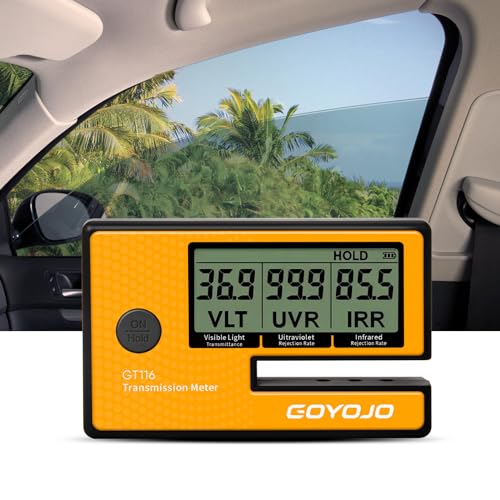
The GOYOJO Labs model combines comprehensive 3-in-1 testing with practical data handling. It provides UV transmission, IR transmission, and overall light transmittance readings, accompanied by a data lock feature that preserves results after testing. A robust tool for automotive window tint shops, it supports glass and filmed samples up to 8 mm thick and emphasizes efficiency in busy workflows.
- 3-in-1 VL/UV/IR readings
- Data lock for easy result retention
- Test samples up to 8 mm thick
- Efficient operation suitable for shops
Landtek Window Tint Meter

The Landtek model stands out with an auto-rotating display that makes it easy to read measurements from various angles. It supports multiple display modes to suit user preference, and its 3-in-1 capabilities provide a straightforward readout of UVR, IRR, and VLT. This design is particularly convenient for technicians who rotate windows during inspection and need flexible viewing options.
- Auto-rotating display for convenient viewing
- Three display modes: UVR/IRR/VLT, UVT/IRT/VLT, and VLT
- 3-in-1 measurement for comprehensive testing
Buying Guide
Choosing the right window tint meter depends on how you plan to use it. Consider measurement capabilities, compatibility, accuracy, and workflow integration to pick a model that fits your needs. Here are the main factors to evaluate.
Core measurement capabilities
Look for meters that report visible light transmittance (VLT), ultraviolet rejection (UVR), and infrared rejection (IRR). These three values cover the essential metrics used to verify tint legality and film performance. Some models also display alternative readouts or modes to match different inspection protocols.
Physical compatibility and testing range
Check the maximum test sample thickness and whether the device supports glass or film up to that limit. Several meters in this list test up to 8 mm thick. If you work with roll-down windows, ensure the device is designed for that use. Some meters explicitly limit testing to certain window types, which matters for professionals with a broad client base.
Calibration, accuracy, and standards
Consider models that offer automatic calibration or are traceable to standards like NIST. Calibration reduces drift over time and supports consistent results across jobs. For shops that must document compliance, an option with traceability adds credibility to the readings.
Display usability and power
A clear, readable display is essential, especially under bright shop lighting. Rotating or multi-mode displays can improve readability at different angles. Battery life, included recharge options, and portability affect how you deploy the meter on-site.
Data handling and durability
Some meters offer data locking to preserve results after testing, which helps with record-keeping and audits. Robust casings, case inclusion, and ease of transport are important for a device that moves between vehicles and job sites.
Professional vs DIY and value considerations
Professional auto shops typically prioritize accuracy, durability, and traceability, while DIY users may value portability and ease of use. Budget models can be appealing for occasional testing, but label and verify that the device meets your required standards. When possible, compare models with similar features to assess true value beyond price.
Model quick-reference
| Model | Notable Features | Best For |
|---|---|---|
| TM-26 | 8 mm slot; VL/UVR/IRR readings | General automotive tint testing and demonstrations |
| Enforcer II | NIST-traceable; USA-assembled; Battery included | Professional shops requiring documented accuracy |
| Mxmoonfree | 8 mm slot; 3-in-1; Roll-Down Windows Only | Roll-down window testing and quick checks |
| GOYOJO Labs | Data lock; 3-in-1; 8 mm slot | On-site job tracking and robust data handling |
| Landtek | Auto-rotating display; 3 display modes | Flexible viewing and multi-mode readouts |
Across these options, the best window tint meter depends on scale of use, required documentation, and the types of windows you service. For shops with strict compliance needs and frequent on-site testing, models with NIST traceability and easy data retention offer clear advantages. For DIY projects or demonstrations, portability, straightforward operation, and a strong display may matter more than official certification. The five models highlighted above cover a spectrum of use cases while emphasizing accuracy, usability, and durable construction.