Choosing the best value for a deep cycle battery means weighing capacity, longevity, maintenance needs and safety against upfront cost. AGM models offer maintenance-free operation and spill-proof design, while LiFePO4 cells promise many more charge cycles and far lighter weight. This guide highlights five dependable choices that balance price and performance for off-grid cabins, RVs, boats, trolling motors and solar setups. The selections emphasize standard 12V systems with 100Ah or close capacity and proven reliability. The table below profiles each option to help compare core specs at a glance.
| Product | Brand | Type | Capacity (Ah) | Notable |
|---|---|---|---|---|
| Renogy Deep Cycle AGM 12V 100Ah | Renogy | AGM Lead-Acid | 100 | 3% self-discharge; maintenance-free; scalable in series/parallel (up to 4P) |
| Weize Deep Cycle AGM 12V 100Ah | WEIZE | AGM Lead-Acid | 100 | Maintenance-free; low self-discharge; 1100A max discharge |
| Interstate Marine Deep Cycle 12V 100Ah | Interstate Batteries | AGM Lead-Acid | 100 | Extreme deep-cycle power; 2x-3x longer life vs conventional batteries; thick plates |
| Eiiev 12V 100Ah LiFePO4 Battery | Eiiev | LiFePO4 | 100 | Grade A+ LiFePO4 cells; UL-certified; lightweight; 4000–15000 cycles |
| Rvpozwer 12V 100Ah LiFePO4 Battery | Rvpozwer | LiFePO4 | 100 | Built-in 120A BMS; 4000–15000 cycles; expandable in series/parallel |
Renogy Deep Cycle AGM 100Ah Battery

Renogy’s 100Ah AGM deep cycle battery is designed for RVs, camping, cabins and marine off-grid systems. Its sealed AGM chemistry provides a maintenance-free, spill-proof design with strong safety margins. The manufacturer notes that Renogy AGM batteries are trusted worldwide, with a history of performance and safety. The cell chemistry supports series connections with no inherent limitation and can be paralleled up to four units, which helps scale capacity for growing power needs. The unit’s internal structure and sealed design reduce troubleshooting compared with other chemistries, a feature that can simplify long-term maintenance in remote locations. With more than 230,000 units sold over six years, the model demonstrates broad real-world usage and reliability.
In practical terms, this 100Ah option offers solid daily reserve for mid-sized off-grid setups or recreational use. The 3% self-discharge rate helps with storage between trips, and its maintenance-free posture means fewer charging chores on a schedule. For users expanding a solar array or running essential cabin circuits, the Renogy 100Ah AGM presents a balanced mix of safety, durability and cost. It remains suitable for light trolling-motor setups, small inverters and household loads in remote locations. Overall, it represents dependable value among widely available AGM options.
Weize Deep Cycle AGM 12V 100Ah Battery
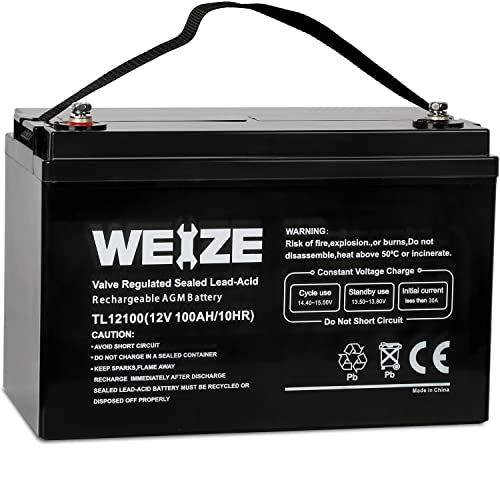
WEIZE’s 100Ah AGM battery emphasizes maintenance-free operation and reliability under demanding conditions. It uses an absorbent glass mat (AGM) design to prevent leaks and support sealed performance. The product notes a practical 1–3% self-discharge per month, which makes it suitable for seasonal storage without frequent recharging. In addition, its 1100A maximum discharge current supports short bursts of energy for starting or trolling-motor use, while maintaining a stable day-to-day power supply for RVs, solar systems and marine applications. The battery’s robust construction and sealed design help reduce the frequency of troubleshooting in off-grid situations.
Weize stresses a broad operating temperature range to support charging and discharging in varied climates, and emphasizes a longer storage lifespan when kept adequately charged. For value-focused buyers, the 100Ah capacity paired with maintenance-free AGM chemistry often delivers a straightforward, cost-effective upgrade for mid-sized off-grid or recreational setups where weight and space are considerations. The model is well suited for solar array support, trolling motors and light-duty marine gear, delivering predictable performance across typical weekend-use scenarios.
Interstate Marine Deep Cycle 12V 100Ah

Interstate Batteries markets this 100Ah marine deep-cycle AGM battery as an option that combines high-cranking power with extended deep-cycle capacity. The claim of “2X-3X more battery life” versus conventional flooded batteries highlights the potential long-term value of choosing a robust AGM design for marine and recreational use. Thick plates are noted as part of the construction to support repeated discharge cycles while maintaining performance. This model is positioned for boating applications, including powering trolling motors, electronics, and accessories without sacrificing reliability in adverse marine environments. The emphasis is on durable, long-lasting power for demanding on-water uses.
From a value perspective, the Interstate 100Ah AGM offers solid endurance and wide compatibility with standard 12V systems. Its robust construction aims to resist the vibration and humidity typical of marine settings, helping ensure steady deliveries of energy for extended trips. For buyers balancing upfront cost with longevity and a marine-specific form factor, this option provides a pragmatic balance of performance and durability within the 100Ah class.
Eiiev LiFePO4 100Ah Battery

Eiiev’s 12V 100Ah LiFePO4 battery uses Grade A+ LiFePO4 cells with high energy density and stable performance. The cells meet UL testing standards, providing an added layer of assurance for safety. The battery weighs about 24.25 pounds, making it substantially lighter than many lead-acid options—an important consideration for portable off-grid setups and RVs. Eiiev advertises a long cycle life with claims of 4000–15000 cycles depending on depth of discharge, highlighting a potential lifetime value over traditional lead-acid packs. A built-in protection framework contributes to reliable operation across varied temperatures and loads.
For buyers prioritizing lightweight power and longevity, this LiFePO4 option offers a compelling value proposition. The combination of safety certification, substantial cycle life and reduced weight makes it suitable for solar-powered cabins, RVs, trolling motors and other off-grid appliances where long-term power density matters more than initial cost. While LiFePO4 packs require higher upfront investment, the long-term durability and cycle life can outperform traditional AGM batteries in demanding environments.
Rvpozwer 12V LiFePO4 100Ah Battery

Rvpozwer presents a 12.8V 100Ah LiFePO4 battery with a built-in 120A BMS designed to safeguard against overcharge, over-discharge, over-current, over-voltage and short circuits. The specified lifespan is generous, promising up to 4000 cycles at 100% depth of discharge, 6000 at 80% DOD, and as many as 15000 at 60% DOD. The battery is described as compact and expandable, with the ability to connect up to four units in series for higher voltage or in parallel for greater capacity. It is designed to meet Group 31 standards and is positioned for RVs, trolling motors, solar systems and off-grid power needs.
From a value standpoint, the Rvpozwer LiFePO4 option emphasizes safety, longevity and modular expansion. The inclusion of a robust BMS and the potential for significant cycle counts can translate to lower replacement frequency and predictable performance in challenging environments. While LiFePO4 packs are typically more expensive upfront, the long cycle life and scalable configuration provide clear long-term value for serious off-grid, marine and RV users who require reliable, high-quality energy in a compact package.
Buying Guide
When selecting a value-focused deep cycle battery, consider how you intend to use the power and which tradeoffs matter most. The following purchase considerations address common scenarios and help compare the five options above.
- Battery chemistry and safety: AGM lead-acid batteries are well-known for robustness and lower upfront costs, with maintenance-free operation and sealed designs that prevent leaks. LiFePO4 cells offer significantly longer cycle life and lighter weight, but at a higher initial price. If long-term durability and weight reduction matter, LiFePO4 can be the better value over time.
- Capacity and depth of discharge: 100Ah capacity is a common target for mid-sized systems. LiFePO4 batteries generally support deeper discharges safely, enabling more usable energy per cycle than many lead-acid packs. For solar or off-grid cabins, deeper cycles and higher usable capacity can improve overall value.
- Cycle life and warranties: LiFePO4 options often advertise thousands of cycles and times as high as 4000–15000 cycles, which can outweigh higher upfront costs for continuous use. AGM options typically provide hundreds to a couple thousand cycles with stable performance, depending on usage and maintenance practices.
- Weight and form factor: LiFePO4 packs are substantially lighter than lead-acid equivalents, easing installation and reducing structural load in boats and RVs. Weight considerations are important for trolling motors and portable setups.
- Maintenance and safety features: Sealed AGM models minimize spills and venting, while LiFePO4 packs include sophisticated BMS to guard against misuses such as overcharge or short circuits. For remote locations, these protections can translate into lower risk and less hands-on maintenance.
- Temperature tolerance: AGM batteries tolerate a wide temperature range but can lose capacity in extreme cold. LiFePO4 chemistry often performs well across broad temperatures, but performance can still be affected by very cold environments without proper insulation or charging strategies.
- System integration: If you plan to connect multiple units in series or parallel, ensure the chosen battery supports safe balancing and expansion. Several models in this guide advertise compatibility with series/parallel configurations, which is beneficial for scaling power.
- Space and practical constraints: A 100Ah LiFePO4 pack delivers high energy density with lighter weight, which can be a decisive advantage for compact installations or portable power packs on boats or RVs.
- Cost of ownership: Compare total ownership costs by factoring upfront price, cycle life, maintenance needs, and the expected replacement interval. LiFePO4 may involve a higher initial investment but lower replacement frequency and maintenance can lower lifetime costs.
Across these options, the Renogy and Weize AGM models deliver strong value for typical off-grid and marine applications, offering solid performance with straightforward maintenance and broad availability. The Interstate AGM option emphasizes rugged marine durability and extended life in challenging environments. The Eiiev and Rvpozwer LiFePO4 batteries provide longer cycle life and lighter weight, delivering long-term value for users who can justify the higher upfront cost. Selecting the best fit depends on how you balance price, weight, cycle life and integration needs in your setup.