Choosing a reliable tiller outboard motor is essential for maneuverability, ease of use, and efficient propulsion on small craft. The following selections cover various power ranges, hard-wearing materials, and practical features like water cooling and CDI ignition. Use this guide to compare performance, fuel efficiency, and installation simplicity across popular models.
| Product | Brand | Power | Key Feature | Image |
|---|---|---|---|---|
| BJTDLLX Short Shaft | BJTDLLX | 12 HP | Water cooling, CDI ignition, three-speed cruise |  |
| awolsrgiop 2 Stroke 18HP | awolsrgiop | 18 HP | Three-blade propeller, anti-swirl plate |  |
| LIWBYYG 18HP 246CC | LIWBYYG | 18 HP | Water cooling, CDI ignition, long range |  |
| Newport NT300 Electric | Newport Vessels | 3 HP (electric) | Ultra-quiet, digital throttle, long range |  |
| DNYSYSJ 3.5 HP | DNYSYSJ | 3.5 HP | 2-stroke, manual start, easy operation |  |
Note: This summary highlights five relevant models suitable for small boats, inflatables, and kayaks. Each entry includes a brief look at build quality, cooling and ignition, control type, and typical use cases to help you decide which motor fits your vessel and cruising needs.
BJTDLLX Short Shaft 12HP Outboard
The BJTDLLX 12 HP two-stroke outboard is designed for small boats up to roughly 19.69 feet and under 661 pounds. It features water cooling to maintain engine temperatures and extend service life, with a vent design that further supports longevity. The aluminum construction resists fracture, corrosion, and deformation in water environments, making it suitable for inflatables, fiberglass, and wooden boats. The engine delivers a practical thrust range of 661-1763 pounds and speeds roughly between 8 and 30 km/h. Three forward gears plus neutral and reverse provide flexible cruising options. The package is intended for straightforward installation, allowing boaters to enjoy a stable, comfortable ride with predictable throttle response and cruising control.
awolsrgiop 18HP Two-Stroke Outboard
This 18 HP two-stroke model emphasizes power and durability with a robust aluminum alloy housing. It supports a maximum load around 2,204 pounds to accommodate larger boats or heavier equipment. The engine uses a three-blade propeller and a streamlined design to maximize propulsion efficiency. A stable three-speed cruise system (forward, neutral, reverse) and stepless speed control help maintain a smooth ride. A CDI ignition system ensures quick starts, while water cooling manages heat under sustained operation. An anti-swirl plate helps reduce wave turbulence and keeps water from splashing onto the operator, contributing to comfortable handling on choppier days.
LIWBYYG 18HP 246CC Outboard
LIWBYYG’s 18 HP outboard pairs a 246cc engine with water cooling and a CDI ignition system to deliver reliable starts and consistent performance. The motor ships with a long shaft and a 8-inch, three-blade propeller designed to cut efficiently through water. This model emphasizes heat management, with multiple cooling holes and a dedicated water-cooling circuit. It offers a solid fuel range for longer trips, and a tail plate clamp helps keep the engine securely mounted. Users can expect strong acceleration and stable cruising, with a focus on endurance and smooth handling in a range of water conditions. The included design also seeks to balance power with efficient fuel consumption.
Newport NT300 Electric Outboard
The Newport NT300 is an electric outboard delivering about 3 HP equivalent (1300 watts) with 110 pounds of thrust, suitable for lighter vessels and calm-water exploration. Its brushless direct-drive design promises quiet operation, with a digital throttle and LCD display for easy monitoring. A 24.6″ shaft length and a 9.8″ two-blade propeller provide compact, efficient propulsion. Trim and tilt angles support different water conditions, and field-oriented control ensures responsive handling. With a maximum range of up to 66 miles on a single charge and runtime up to 30 hours, this motor emphasizes endurance, minimal maintenance, and low noise—ideal for anglers or recreational boaters who value quiet operation and reliability in a compact package.
GOSHET 4-Stroke 4HP Short Shaft
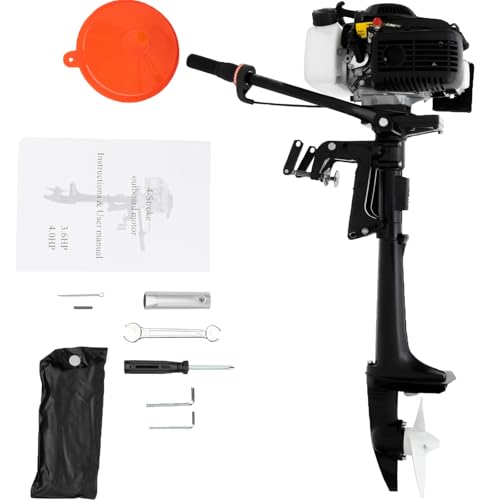
This 4-stroke model delivers up to 4 HP with a 6.3″ three-blade propeller to balance speed and stability. The aluminum build resists corrosion and deformation, making it suitable for water environments. An air-cooling system assists in maintaining engine temperature under load, while a CDI ignition system provides reliable starts. The short shaft design simplifies mounting on smaller craft, and the tilt-inspired mechanics help manage water resistance during operation. This motor is positioned for anglers and small-boat users who prioritize a steady, manageable propulsion option with straightforward maintenance.
LIYUANJUN 18HP 246CC Outboard

LIYUANJUN’s 18 HP outboard combines a 246cc two-stroke engine with CDI ignition and water cooling for reliable starts and sustained performance. A 24L/6.3 gallon extra fuel tank enables longer cruising between refuels, while the two-cylinder design and 2.08 gear ratio support stable operation in various conditions. The engine supports forward, neutral, and reverse gears and includes manual start. The tiller control interface prioritizes straightforward operation and accessible maintenance. This model targets boaters who want stronger mid-range power with extended range for longer trips on rivers or coastal waters.
DNYSYSJ 2 Stroke 3.5HP
The DNYSYSJ 3.5 HP two-stroke outboard is designed for smaller craft and quick starts with a manual pull. It features a balanced 2-stroke design capable of about 3.5 HP and a maximum speed around 20 km/h with four people aboard. The unit emphasizes ease of use and reliable performance for basic tasks such as trolling or light cruising. While not the most powerful option, it offers a compact, economical choice for hobbyists who want simple propulsion with straightforward maintenance and operation on small boats.
Buying Guide: Key Purchase Considerations And Comparisons
- Power and boat size: Match horsepower to boat length, weight, and intended use. Smaller inflatables and kayaks benefit from mid-range HP, while larger dinghies may require higher HP or electric options for quiet, extended cruising.
- Fuel type and efficiency: Two-stroke engines typically offer higher power-to-weight ratios but require more maintenance and fuel. Four-stroke units are cleaner and generally more efficient but can be heavier. Electric models provide quiet operation and minimal maintenance but require charging infrastructure and range planning.
- Cooling system: Water cooling is common and helps maintain performance, especially in longer runs. Air cooling is simpler but may heat up more quickly under heavy loads.
- Ignition system: CDI ignition enables reliable starts but check availability of service and replacement parts in your region. Electric start or manual pull start options affect ease of use.
- Control and mounting: Tiller control is straightforward for many crafts, but shaft length (short vs. long) should align with transom height. Ensure a secure mounting system and compatible propeller to maximize thrust and efficiency.
- Durability and materials: Aluminum housings resist corrosion and impact. Look for reinforced components, anti-swirl plates, and robust propellers for extended life in challenging waters.
- Maintenance and serviceability: Consider models with readily available spare parts, water pumps, and CDI components. Simpler maintenance reduces downtime and total cost of ownership.
- Noise, vibration, and comfort: Water-cooled, well-insulated engines produce less heat and run more quietly. Anti-vibration features and ergonomic tiller controls improve handling and user experience.
- Warranty and support: Check manufacturer warranty duration and availability of local service centers or authorized dealers for parts and repairs.
When selecting a tiller outboard motor, balance power needs, vessel type, and runtime expectations. Some options prioritize maximum speed and thrust, while others emphasize quiet operation, fuel efficiency, or extended range. Consider the typical water conditions you encounter, such as calm lakes versus choppy coastal areas, to determine whether you need advanced cooling, a CDI ignition, or a robust three-blade propeller. Finally, review installation ease and maintenance availability to ensure dependable performance over time.