Finding a reliable portable charging option for electric vehicles means considering charge speed, safety features, compatibility, and portability. The products below are selected for American drivers who need flexible, on-the-road charging or emergency power. Each option offers a different mix of Level 1/2 charging, USB power, or jump-start capability to keep you moving. This guide compares five strong contenders so you can choose the right portable charger for your EV or plug-in hybrid.
| Product | |||
|---|---|---|---|
| Jump Starter with Air Compressor (WNDFLV) | Portable Jump Starter & Inflator | High peak power with tire inflation capability | Emergency start, tire inflation roadside |
| Schumacher 1000 Peak Amp Jump Starter | Portable Lithium Jump Box + USB & LED | Compact emergency power and charging | Vehicle start and USB device charging |
| Raylix 16A Level 1/2 EV Charger | EV Charger (J1772) with 21 ft Cable | Flexible Level 1 & 2 charging | Home or travel charging for all J1772 EVs |
| Lectron EV Charger with 16 ft Cable | Portable J1772 EV Charger | Extended cable and reliable Level 1 charging | Overnight or routine home charging |
| ELEGRP Level 1/2 EV Charger | J1772 Charger with 25 ft Cable | PBE & LCR tech for safe, cooler charging | Home or travel charging with dual volt options |
Note: All five options are designed for American drivers and complementary to a home charging setup, offering portability, safety, and compatibility with common EV standards.
Jump Starter With Air Compressor

This model from WNDFLV combines a high 5000A peak jump start with an onboard air compressor rated up to 160 PSI. It is engineered to start large engines—up to 9.0L gas or 8.0L diesel—and run multiple boost cycles in seconds. Real-time tire pressure monitoring, automatic stop inflation, and multiple unit readouts (PSI, BAR, KPA, KG/cm²) provide a versatile inflator option for on-road maintenance. Safety protections cover reverse connection, overcurrent, overvoltage, overload, and overcharge/discharge. The smart jumper cables help prevent sparks and provide instant operation feedback, which is valuable for emergency scenarios.
Schumacher 1000 Peak Amp Jump Starter

Schumacher’s lithium jump box delivers 1000A of starting power and supports charging devices via USB ports. It’s compact enough to fit in a glove box and recharges in about four hours. Beyond jump starting, the unit functions as a portable USB power bank and features an LED emergency light with steady, SOS, and strobe modes. This makes it a practical multipurpose tool for emergency vehicle power and everyday device charging, especially when traditional outlets are unavailable.
Raylix 16A Level 1/2 EV Charger
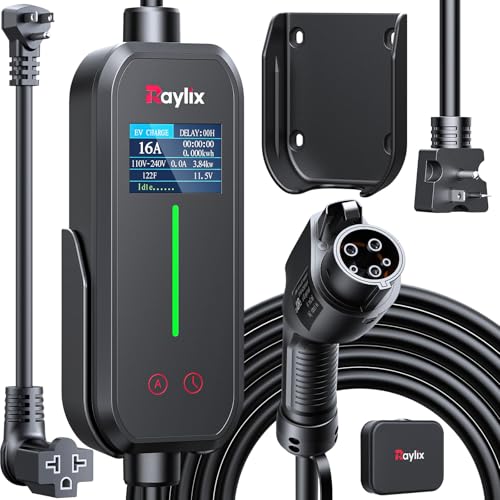
Raylix offers a Level 1/2 EV charger with universal compatibility for SAE J1772 EVs and plug-in hybrids. It features an adjustable current with useful safeguards like delayed charging to help manage electricity costs. The built-in display provides at-a-glance status and settings, reducing the need for app-based monitoring. Its 21-foot cable length adds reach for a variety of parking scenarios, whether at home or away from a dedicated charging station.
Lectron EV Charger, 16 ft Cable

Lectron’s Level 1 charger emphasizes affordability with a 16-foot extension cord and J1772 compatibility for all standard EVs. It supports overnight charging with reliable Level 1 speeds, offering a practical solution for daily home use or while on the road. The charger is noted for its portability and straightforward operation, making it a good choice for drivers who want simple, dependable charging with minimal setup.
ELEGRP Level 1/2 EV Charger

ELEGRP brings dual-mode charging with a 25-foot cable and support for both Level 1 (120V) and Level 2 (240V) charging. It incorporates PBE and LCR technology for enhanced safety, reliable conductivity, and cooler operation during charging. Compatibility spans BEVs and plug-in hybrids, making it a versatile option for home charging with robust protection against electrical faults and overloads.
Buying Guide: Key Considerations For Portable EV Chargers
- Charging level and speed: Level 1 chargers offer slower speeds but are simpler to use, while Level 2 chargers provide faster charging for daily use. Consider your typical driving pattern and how quickly you need a charged battery.
- Vehicle compatibility: Ensure the charger uses the common J1772 standard for most US EVs and plug-in hybrids. If you drive a Tesla, adapters may be needed.
- Cable length and portability: Longer cables improve reach, but heavier units can be less portable. Balance length with weight and storage considerations for your vehicle and trunk space.
- Safety features: Look for built-in protections such as overcurrent, leakage, overload, and thermal management. A display or indicator lights help you monitor charging status safely.
- Smart features and scheduling: Some chargers offer delayed charging or programmable schedules to take advantage of off-peak rates and reduce electricity costs.
- Auxiliary power: If you want a multi-use device, consider models with USB ports or LED lighting for emergency use and device charging beyond EV charging.
- Durability and outdoor use: If you park outside, choose IP-rated or weatherproof units designed for outdoor use in varied temperatures.
- Portability vs. performance: Jump starters provide emergency power and inflating capability, while dedicated EV chargers emphasize longer-range charging. Your choice depends on whether you need a roadside starter, a home charging companion, or both.
Overall, the best portable EV charging option depends on your vehicle type, daily driving needs, and whether you prioritize emergency power, on-the-go charging, or a combination of both. The selections above provide a spectrum of capabilities—from fast Level 2 charging to multipurpose jump starters—so you can pick a solution that best fits your lifestyle and travel routine.