Riding safety starts with properly inflated tires. An accurate motorcycle tire gauge helps you dial in the correct pressure for optimum grip, handling, and tire longevity, whether you’re commuting, touring, or tracking weekends. This guide highlights five top gauges that balance precision, durability, and ease of use, with options for digital accuracy and rugged analog reliability. Each pick is evaluated on accuracy, build quality, and how well it serves riders across varying conditions and bikes.
| Product | Brand | PSI Range |
|---|---|---|
| JACO ElitePro Digital Tire Pressure Gauge – 200 PSI | JACO Superior Products | 0–200 PSI |
| ETENWOLF T300 Digital Tire Pressure Gauge | ETENWOLF | 3–200 PSI |
| Counteract MKPG-D Analog Tire Gauge | Counteract | 5–50 PSI |
| PUIBERS Motorcycle Tire Pressure Gauge | PUIBERS | 0–60 PSI |
| JACO ElitePro Tire Pressure Gauge – 100 PSI | JACO Superior Products | 0–100 PSI |
JACO ElitePro Digital Tire Gauge (200 PSI)

The JACO ElitePro Digital Tire Gauge combines professional-grade accuracy with rugged construction. It uses dual pressure sensors certified to ±0.50% FS (1 PSI) and reads up to 200 PSI with a precise 0.10 PSI resolution. Built from solid brass and steel, it includes a shock-resistant guard to protect against drops. The 10-inch HybridFlex hose and a 360-degree swivel chest ensure easy access to the valve from any angle, while the built-in air bleeder lets you adjust pressure in real time without resetting the display. This gauge is designed for motorcycles, cars, trucks, and RVs, delivering shop-grade reliability in a handheld tool.
- ANSI 2A accuracy, dual sensors, ±0.50% FS (1 PSI)
- 0.10 PSI resolution up to 200 PSI
- 100% brass and steel construction with shock-resistant guard
- 10″ HybridFlex hose and 360° swivel chuck
- Built-in air bleeder for real-time pressure adjustment
- Lock-on display until reset; versatile for multiple vehicle types
ETENWOLF T300 Digital Gauge (3–200 PSI)

The ETENWOLF T300 is a versatile digital gauge suited for motorcycles and general use. It’s calibrated to ANSI B40.7 Grade 2A with an accuracy of ±1 PSI, and covers a broad pressure range from 3 to 200 PSI, making it adaptable to most tires. A key feature is its AI-based thermal compensation, enabling stable readings in extreme temperatures from -4°F to 130°F (-20°C to 54°C). The gauge is designed for rugged environments, quick measurements, and clear digital readings, helping riders maintain proper inflation in diverse weather and terrain.
- ANSI B40.7 Grade 2A ±1 PSI
- 3–200 PSI measurement range
- AI thermal compensation for temperature extremes
- Operates reliably from -4°F to 130°F
Counteract MKPG-D Analog Tire Gauge

The Counteract MKPG-D represents rugged, straightforward analog measurement for motorcycle and ATV tires. It features a 90-degree head, which helps access difficult valve stems, and an all-metal construction designed for durability under tough conditions. The 5–50 PSI readout is ideal for motorcycles, ATVs, and smaller transport tires where quick, reliable readings are essential. While analog gauges require no batteries, users should check calibration periodically to maintain accuracy over time.
- Analog gauge with 5–50 PSI range
- 90-degree head for hard-to-reach stems
- All-metal construction for durability
- Compact, dependable design for motorcycles and ATVs
PUIBERS Motorcycle Tire Pressure Gauge

The PUIBERS mechanical gauge uses a bronze bourdon tube, delivering a reliable, battery-free reading with a luminous dial for low-light visibility. It is designed for motorcycles and other vehicles, with a 60 PSI range and a 90-degree right-angle chuck, making it easy to reach valve stems in tight spaces. The device emphasizes durability through brass construction and a flexible hose, suitable for riders who value a robust, simple gauge that performs reliably in varied conditions.
- Bronze bourdon tube, battery-free
- Luminous dial for night visibility
- 60 PSI range with 90-degree chuck
- Flexible hose and brass construction for durability
JACO ElitePro Tire Gauge (100 PSI)
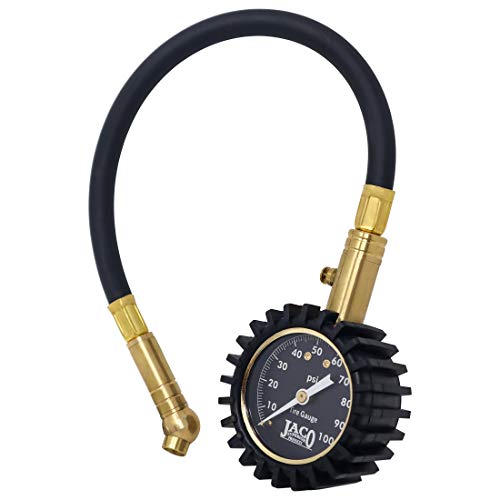
The JACO ElitePro 100 PSI model is a robust, battery-free gauge built for consistent accuracy. It adheres to ANSI standards with an accuracy of roughly ±1.5% at a certified calibration facility. The device uses a solid brass body shielded by a shock-resistant guard and features a HybridFlex leak-proof hose for durability and flexibility. A built-in air bleeder reduces overinflation, and a 360-degree swivel chuck makes access to tight valve stems straightforward across motorcycles, trucks, and light vehicles.
- ANSI standards-based accuracy (approx. ±1.5%)
- Battery-free operation with brass construction
- HybridFlex hose and 360° swivel chuck
- Built-in air bleeder for fine adjustments
- Rugged, compact design for on-the-road use
Buying Guide: Key Considerations For Selecting A Motorcycle Tire Gauge
Choosing the right tire gauge depends on how you ride and what matters most to you. Here are the main factors to weigh, along with practical guidance for both digital and analog options.
- Accuracy and range: Digital gauges typically offer fine resolution (as low as 0.1 PSI) and broad ranges (3–200 PSI or more). Analog gauges excel in durability and battery-free operation but may require careful calibration checks to maintain precision.
- Gauge type: Digital gauges provide easy-to-read numeric displays, backlighting, and automatic features, while analog gauges deliver straightforward operation and often greater ruggedness for harsh environments. Consider your riding style and lighting conditions when choosing.
- Durability and materials: Look for brass or alloy bodies, reinforced housings, and high-quality hoses. For motorcycles, a compact, shock-resistant design helps resist vibrations and occasional drops.
- Hose length and chuck style: A 6–12 inch hose with a 360-degree swivel or quick-attach chuck eases access to valve stems on sport bikes and touring bikes, especially when space is tight or the wheel is angled.
- Ease of use: Features like a built-in air bleeder, auto-off, and easy zeroing simplify frequent checks while riding or during maintenance sessions.
- Battery life and maintenance: Digital gauges rely on batteries; check battery type, replacement availability, and how long readings stay on before auto-off. Analog gauges avoid battery concerns but require periodic calibration checks.
- Calibration and certification: Reputable models cite ANSI/B40.x standards or equivalent certifications. Regular calibration ensures readings remain trustworthy, especially if you use gauges across multiple vehicles.
- Readability in all conditions: For night rides or dawn patrols, a backlit display or luminous dial improves readability. Analog dials with clear graduations are also effective in low-light settings.
- Value vs. features: Consider whether you regularly inflate to high pressures or need a gauge that handles a wide range. A feature-rich gauge with an automatic bleeder and durable construction can justify a higher price for everyday riders.
Take stock of your bike type, typical riding conditions, and storage possibilities. If you frequently ride in low light, a gauge with a luminous dial or a backlit display can reduce error. For enthusiasts who rely on precise, repeatable measurements across multiple vehicles, a digital gauge with a wide PSI range and a quality hose is often worth the investment. If you prioritize simplicity, a rugged analog gauge with a 5–50 PSI range may suffice for sport bikes and dirt bikes that rarely require high-pressure checks.