Whether you’re a DIY enthusiast or a professional mechanic, a low-profile car jack helps you access low ground clearance vehicles without fuss. This guide highlights five highly rated low-profile floor jacks, each designed to fit under most sedans and many SUVs while delivering solid lifting power and stable support. By comparing lifting heights, weight capacity, maneuverability, and safety features, you can pick the right jack for your garage or shop.
| Product | Brand | Capacity | Lift Range |
|---|---|---|---|
| TONDA Low Profile Car Jack | TONDA | 5,000 lb | 3.35″ – 14.57″ |
| BIG RED 2.5 Ton Low Profile Hydraulic Trolley Jack | BIG RED | 5,000 lb | 3.33″ – 15″ |
| Pro-Lift F-767 Grey Low Profile Floor Jack | Pro-Lift | 2,000 lb | 3.375″ – 15″ |
| Jack Boss 3 Ton Low Profile Floor Jack | Jack Boss | 6,600 lb | 3-15/16″ – 18-5/16″ |
| Cat 4500 Pound Xtra Low-Profile Jack | Cat | 4,500 lb | 2-3/4″ – 15-1/2″ |
TONDA 2.5 Ton Low Profile Floor Jack

The TONDA low profile jack blends compact height with strong lifting power. It offers a minimum height of 3.35 inches and a maximum height of 14.57 inches, making it suitable for most family cars and many sport utilities. With a capacity of 5,000 pounds, this jack supports tire changes, brake work, and maintenance tasks with confidence. Its robust steel construction emphasizes safety and stability, while mobility is enhanced by two large steel casters, two 360-degree swivel casters, and a detachable long handle for easy transport around the garage.
- Lift range: 3.35″ to 14.57″
- Capacity: 5,000 lbs
- Two large steel casters and two 360-degree swivel casters
- Detachable long handle for easy transport
BIG RED 2.5 Ton Low Profile Hydraulic Trolley Jack

The BIG RED jack is built for low-profile access with a minimum lift height of 3-1/3 inches and a maximum height of 15 inches. It handles up to 5,000 pounds, making it suitable for a broad range of sedans and SUVs. The jack features a built-in safety valve for overload protection and a rust-resistant finish to resist wear. A safety bypass system helps prevent over-loading, contributing to safer operation during lifts and maintenance tasks.
- Lift height: 3-1/3″ to 15″
- Capacity: 5,000 lbs
- Built-in safety valve; rust-resistant finish
- Safety bypass system for overload protection
Pro-Lift F-767 Grey Low Profile Floor Jack – 2 Ton

The Pro-Lift F-767 offers an extra low profile with a lifting range from 3-3/8 inches to 15 inches. Its solid steel construction and safety release valve are designed to secure user safety during lifts. A patented bypass device protects against over-pumping, helping ensure safe operation when raising a vehicle. This model is a practical option for everyday maintenance on a wide array of vehicles while remaining compact enough to maneuver around a busy garage.
- Lift range: 3-3/8″ to 15″
- Capacity: 2,000 lbs
- Solid steel construction; safety release valve
- Patented bypass device to prevent over-pumping
Jack Boss 3 Ton Low Profile Floor Jack
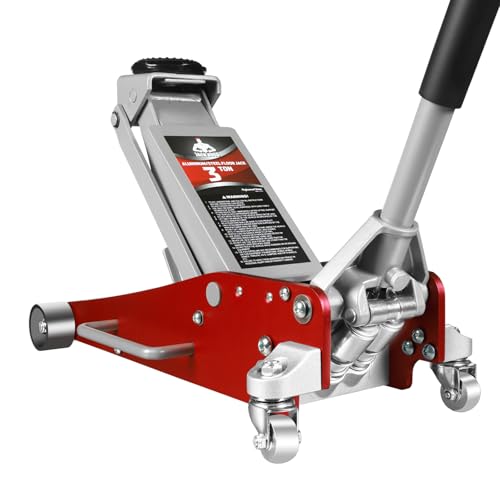
The Jack Boss model combines aluminum and steel for a sturdy 3-ton lift with a low profile design. It delivers a lifting range from 3-15/16″ to 18-5/16″, enabling access under many modern vehicles. Weighing about 58.5 pounds, this jack includes a rubber saddle and a two-piece handle for handling and storage. Its dual pistons provide quicker lifts, making it a practical choice for frequent use in sports utilities, sedans, and light trucks.
- Lift range: 3-15/16″ to 18-5/16″
- Capacity: 6,600 lbs
- Dual pistons for quick lifting; includes rubber saddle and two-piece handle
- Low profile design suitable for low ground clearance vehicles
Cat 4500 Pound Xtra Low-Profile Jack

The Cat Xtra Low-Profile Jack starts at 2-3/4 inches and rises to 15-1/2 inches, designed for classic cars and lowered vehicles. A steel safety bar slides into the lift arm to secure the jack in the maximum height position, enhancing stability during maintenance. Nylon wheels reduce noise and offer smoother movement across shop floors, helping keep vibrations and friction to a minimum during use.
- Lift range: 2-3/4″ to 15-1/2″
- Capacity: 4,500 lbs
- Steel safety bar; nylon wheels for quiet movement
- Secure maximum height with safety bar
Buying Guide
Key purchase considerations
Choosing the right low-profile jack involves balancing vehicle type, lift height needs, and safety features. Begin by assessing your vehicle’s ground clearance and weight. If you frequently work on sports cars or lowered sedans, a jack with a very low minimum height and a robust lifting range is essential. For family cars and SUVs, prioritize higher lift ranges and greater capacity to cover a broader set of tasks. Consider the jack’s weight and maneuverability—aluminum models are lighter, but steel or mixed builds often offer greater durability.
Capacity and lift range
Capacity determines how much weight you can lift safely; exceeding it can compromise stability. Most five-thousand-pound jacks cover a wide range of passenger vehicles, while niche models push toward 6,000 pounds or more. Lift range affects your ability to reach the needed service height. If you plan tire changes, brake work, or suspension tasks on taller vehicles, ensure the max height accommodates the job. Conversely, a very low minimum height is critical for sports cars and coupes with limited clearance.
Low profile design and vehicle fit
A lower profile design helps you slide the jack under a vehicle with minimal ground clearance. Look for a minimum height around 2-3/4″ to 3-3/8″ for broad compatibility with modern sedans and some compact SUVs. If you routinely lift SUVs or vans, verify the maximum height is sufficient for your needs and consider a model with a longer reach or extended lift range. The saddle design and wheel configuration influence how easily the jack positions under the frame.
Safety features and build quality
Safety features are essential in preventing over-lift and instability. Look for a hydraulic jack with a reliable safety valve, a bypass device to guard against over pumping, and a locking mechanism or safety bar at full height. A sturdy steel or mixed-metal frame improves durability, while a well-sealed hydraulic system minimizes leaks. Rubber saddle protection helps prevent damage to the vehicle’s undercarriage. For busy workshops, consider the presence of anti-slip handles and ergonomic controls.
Mobility, maintenance, and storage
Mobility matters when moving the jack between bays or around a garage. Models with large casters and 360-degree swivels offer better maneuverability. Maintenance-wise, check for accessible oil ports and a straightforward release valve; periodic lubrication extends life. Storage footprint is another factor; a compact, low-profile jack occupies less space and fits more easily in a car trunk or tool cabinet. If you need to transport the jack, a detachable handle or lighter alloy construction can simplify loading.
Value, warranty, and support
Value comes from a balanced mix of capacity, lift range, safety features, and build quality. Compare warranties and customer support, as these indicate manufacturer confidence and service availability. A jack that provides solid performance for several years and includes a reasonable warranty often offers better long-term value than a cheaper, lower-quality option. Consider readied replacement parts and easy access to service information as part of the purchasing decision.