Gas and propane generators provide flexible power for homes, RVs, and job sites. This guide highlights top dual‑fuel models, balancing power, safety features, and portability. Each section covers a flagship product, its dual‑fuel capability, starting options, and CO safety sensors to help you compare quickly. The included buying guide helps you assess runtime, outlets, transfer switches, and fuel availability to match your needs.
Summary of selected products
| Product | Brand | Fuel Options | Key Features |
|---|---|---|---|
| DF5600X | WEN | Gas / Propane | 5600 surge / 4500 running watts on gas; 5000 surge / 4050 running watts on propane; Electric start; CO watchdog sensor |
| DF360iX | WEN | Gas / Propane | 3600 surge / 2900 running watts gas; 3500 surge / 2600 running watts propane; ultra‑quiet; clean power for electronics |
| 12500 | Westinghouse | Gas / Propane | Up to 12500 peak / 9500 running (gas); 11200 peak / 8500 running (propane); remote start; multiple outlets; transfer switch ready |
| 6500 | Westinghouse | Gas / Propane | 6500 peak / 5300 running (gas); 5800 peak / 4800 running (propane); CO sensor; transfer switch and RV outlets |
| DS13000MX | DuroStar | Gas / Propane | 13,000 watts; dual fuel; remote electric start; whole‑home backup; CO alert |
WEN DF5600X Dual Fuel Portable Generator

The WEN DF5600X combines flexibility with automatic safety at a practical size. It runs on gasoline with 5600 surge watts and 4500 running watts, or on propane delivering 5000 surge watts and 4050 running watts. An electric start lets you power up quickly by pressing a switch, which is convenient after storms or outages. The included CO watchdog sensor automatically shuts down the generator if dangerous carbon monoxide levels are detected, helping protect occupants. Wheel kit compatibility and a compact footprint support portability for job sites or home use.
Power management details: dual‑fuel means you can select fuel based on availability and needs, from a quick refill to a longer run with propane. For homes that require transfer switches, check compatibility with your preferred setup. The DF5600X is well suited for mid‑sized loads such as refrigerators, sump pumps, lighting, and essential electronics when paired with proper surge handling.
WEN DF360iX Quiet Dual Fuel Inverter Generator

The WEN DF360iX is designed for quiet operation and clean power suitable for sensitive electronics. It offers dual fuel versatility, delivering 3600 surge watts and 2900 running watts on gasoline, and 3500 surge watts with 2600 running watts on propane. Its inverter technology provides stable voltage and a low total harmonic distortion output, reducing the risk of damage to devices like smartphones and laptops. As a compact model, it’s ideal for camping, RVs, or as a portable emergency backup for smaller loads.
Quiet operation is a standout feature, with performance described as comparable to normal conversation in typical environments. When selecting this model, consider expected runtime at your load and the need for USB or USB‑C charging or other modern outlets, which inverter units commonly support with dedicated circuitry.
Westinghouse 12500 Watt Dual Fuel Backup Generator

This Westinghouse model is built for serious power needs with a 457cc engine. It delivers up to 9500 running watts on gas and 8500 running watts on propane, with a generous 12‑hour runtime on a 6.6‑gallon tank. It includes a remote start with a key fob, plus multiple outlets and transfer switch readiness. The unit features a digital display providing real‑time voltage, frequency, and lifetime hours. It is equipped with safety components like rubber‑covered outlets for added protection and a robust design that supports whole‑house backup during extended outages.
Consider the size and weight when planning for installation or storage, as well as the availability of propane as a long‑term fuel option in your area. For homes with transfer switches or RV connections, this model offers a versatile solution with ample outlets for essential circuits.
Westinghouse 6500 Watt Dual Fuel Home Backup Generator
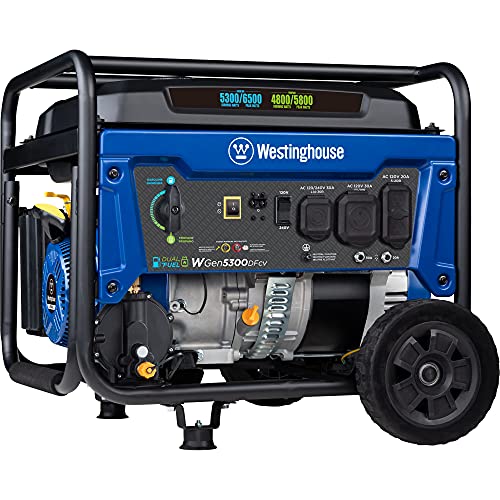
The Westinghouse 6500 Watt model is designed for reliable home backup with dual fuel support. It delivers 6500 peak watts and 5300 running watts on gasoline, and 5800 peak watts with 4800 running watts on propane. Its features include a 4.7‑gallon tank with a fuel gauge, providing up to about 14.5 hours at a standard load. Outlets include a 5–20R 120V duplex receptacle, an RV‑ready TT‑30R 30A, and a transfer switch‑ready L14‑30R 30A. Outlets are protected with rubber covers, and the package often includes wheels, a propane hose, and a starter kit for quick setup. A CO sensor adds safety during operation.
When evaluating this unit, consider the space needed for ventilation and storage, the availability of gas versus propane in your region, and the ease of remote or automatic startup options that suit your home emergency plan.
PowerSmart 4400-Watt Dual Fuel Inverter Generator

This PowerSmart unit offers a solid 4400 starting watts and 3600 rated watts with dual fuel capability. It is designed as a lightweight option with quiet operation, making it suitable for home use, camping, or emergency backup. The fuel tank provides about 11 hours of runtime at 25% load, reducing the need for frequent refueling. While it may not match the high‑end output of larger models, it balances portability with adequate power for essential appliances and electronics. The inverter design helps protect sensitive devices from power irregularities.
Key considerations include the balance of runtime against expected loads, the availability and cost of propane, and the compatibility with any existing transfer switch or home standby system you may use during outages.
Buying Guide: Key Considerations For Dual‑Fuel Generators
- Power needs and peak loads: Match generator wattage to your essential circuits. For whole‑home backup, prioritize higher running watts and peak capabilities, plus a transfer switch readiness rating.
- Fuel flexibility: Dual‑fuel models provide gasoline for high power bursts and propane for longer runtimes. Consider fuel availability, storage safety, and efficiency at different loads.
- Starting method: Electric start offers quick startup; manual recoil is reliable during power outages. Some models include remote start for convenience.
- Safety features: Look for CO sensors or shutdowns, proper outlet covers, and automatic shutdown under low oil or high CO conditions. CO watchdogs enhance home safety.
- Outlets and transfer switches: Ensure the unit includes essential outlets (5–20R, TT‑30R, L14‑30R). Transfer switch compatibility is critical for safe, automatic power transfer in outages.
- Runtime and fuel tank: Larger tanks yield longer runtimes, which reduces refueling interruptions. Consider your typical outage duration and fuel availability.
- Portability and setup: Wheel kits and handles improve mobility. For home use, factor in storage space, noise levels, and emissions compliance for residential areas.
- Maintenance and warranty: Check oil shutdown features, air filters, and service support. A longer warranty provides reassurance for heavy use scenarios.
- Noise levels: Inverter and some dual‑fuel models are designed for quieter operation—important for neighborhoods, campsites, and noise‑restricted areas.
- Emissions compliance: Look for EPA and CARB compliance if you operate generators in regulated regions or near sensitive environments.
Across these options, you should evaluate your anticipated load profile, whether you prefer gasoline for immediate power or propane for longer, steadier fuel availability, and how quickly you need power during outages. A dual‑fuel setup offers flexibility, while features like CO sensors and transfer‑switch readiness enhance safety and integration with home electrical systems.