Dual battery isolator systems help manage power between a primary starting battery and an auxiliary battery, ensuring you can run accessories without risking a dead engine. This guide highlights top-rated dual battery isolator kits available on Amazon, focusing on performance, durability, and ease of installation. We compare voltage-sensitive relays, manual/auto modes, IP ratings, and compatibility with lead-acid, lithium, and other battery types. Whether you own an RV, boat, truck, or ATV, these kits are designed to prevent battery drain while maintaining reliable starting power.
Summary of chosen products: a quick glance at five top picks with key strengths and intended use cases. This table helps you compare voltage thresholds, amperage, and ruggedness at a glance.
| Product | Brand | Amperage | Key Strength | Best For |
|---|---|---|---|---|
| VEVOR Split Charge Relay Kit, 140A | VEVOR | 140 A | Auto 13.3V / 12.8V sensing; easy install | General dual-battery setups |
| Dual Battery Isolator Kit 12V – 140A (VSR) | KeyLine Chargers | 140 A | IP65 rugged, compact | Off-road, marine, trucking |
| VEVOR Dual Battery Isolator Kit, 12V 300A | VEVOR | 300 A | High current; LCD voltmeter; manual/auto | High-demand systems, caravans |
| Nilight 12V 140 AMP Dual Battery Isolator Kit | Nilight | 140 A | IP66 waterproof; voltmeter | RVs, boats, trucks |
| STINGER SGP32 200 AMP Battery Isolator | STINGER | 200 A | High current transfer; reliable | Heavy-use vehicles |
VEVOR Split Charge Relay Kit, 140A

The VEVOR dual battery isolator uses a voltage-sensing relay to connect two batteries when starting voltage is available and to isolate them when the engine is off, preventing drain on the primary battery. It detects 13.3 volts to engage and 12.8 volts to disengage, helping keep your main battery ready to start. The kit supports charging two batteries simultaneously and is designed for RVs, marine craft, cars, trucks, caravans, campers, yachts, ATVs, and UTVs. It comes with a complete installation package and detailed instructions for a straightforward setup. The enclosure and components are built for shock and dust resistance to endure challenging environments.
Designed for diverse contexts, this kit pairs well with under-hood installations and can be integrated into a larger power system with minimal fuss. The robust construction aims to reduce maintenance needs and extend battery life by avoiding unnecessary discharges while preserving starting power for the vehicle.
Dual Battery Isolator Kit 12V – 140A (VSR)

This unit uses a Smart Voltage Sensitive Relay (VSR) to automatically manage charging between two batteries, preventing voltage drops and ensuring your starting battery remains ready. Its 12V system is compact (about 2.6 x 2.6 x 2 inches), making it suitable for under-hood installations or as part of a battery relocation kit. It engages at 13.3V and disengages at 12.8V to optimize charging efficiency. The kit is designed for off-road, marine, and daily driving applications, including trucks, RVs, UTVs, and boats, even when space is limited.
The rugged design supports extreme conditions with IP65-rated protection against water, dust, and vibration. This kit helps maintain consistent power delivery while minimizing parasitic drains on one or both batteries.
VEVOR Dual Battery Isolator Kit, 12V 300A
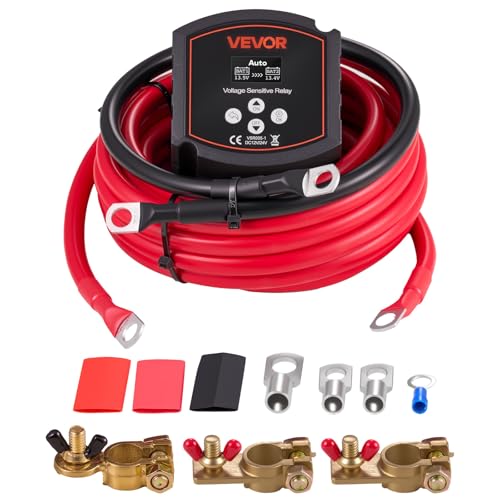
Offering a high 300A rating, this VEVOR kit focuses on heavy-duty applications with both manual and automatic VSR modes. It incorporates a voltmeter and LCD display for real-time monitoring of system voltage and battery state. It’s compatible with lead-acid and lithium batteries, making it versatile for heavy-use vehicles, RVs, UTVs, ATVs, and boats. The included LCD screen helps users track voltages to prevent deep discharge and optimize charging cycles, while the smart isolator prevents cross-loading when the engine is off.
With a focus on reliability, the high current capacity supports larger auxiliary systems and higher power demands, making it suitable for campers, work trucks, and extended-exploration setups where power needs can fluctuate significantly.
STINGER SGP32 200 AMP Battery Isolator

The STINGER SGP32 isolates the primary battery from auxiliary loads with a 200A capacity. It emphasizes maximum current transfer and protection against primary battery discharge, ensuring the engine can start reliably even when auxiliary systems draw power. The unit is designed for demanding environments and is suitable for heavy-use vehicles, including off-road rigs, boats, and service trucks. Its compact footprint and robust build help simplify installation in tight engine bays or chassis spaces while maintaining dependable performance.
For users prioritizing high current handling and straightforward operation, this isolator offers a straightforward path to reliable dual-battery management without complex configurations.
Buying Guide: Key Purchase Considerations and Comparisons
- Amperage capacity: Choose amperage that matches your accessory load and battery bank. Higher amps support heavier loads but may require larger wiring and cooling considerations.
- Voltage thresholds: A voltage-sensitive relay typically engages around 13.3V and disengages around 12.8V. Manual modes provide extra control when needed.
- Battery compatibility: Look for compatibility with lead-acid, AGM, and lithium batteries. Some models specify lithium compatibility, others do not. Ensure the kit supports your battery chemistry.
- Protection features: IP ratings (IP65, IP66, etc.), waterproof seals, and vibration resistance improve reliability in off-road, marine, and dusty environments.
- Installation complexity: Some kits include full accessory packs and detailed instructions for easy setup, while others may require additional hardware or knowledge.
- Monitoring capabilities: LCD screens or voltmeters help track system voltage and battery health, aiding preventive maintenance and battery longevity.
- Durability and materials: Rugged housings, shock resistance, and weatherproof seals protect components in harsh conditions.
- Size and layout: Compact units fit under-hood or tight compartments; verify cable lengths and terminal layout before purchasing.
- Future expansion: If planning more than two batteries or a relocation, consider a kit with scalable capacity and compatibility with larger alternators.
In choosing among these options, consider your vehicle type, typical climate, and usage patterns. For casual weekend use, a mid-range 140A VSR kit with IP66 protection and a voltmeter may suffice. For extended trips, RVs, or marine applications with higher energy demands, a 300A VSR kit with LCD readouts provides greater headroom. High-demand fleets or power-intensive builds may benefit from the 200–300A STINGER or Nilight kits with robust waterproofing and built-in monitoring.