Upgrading to disc brakes can improve stopping power, fade resistance, and overall safety for older vehicles and utility ATVs. This guide highlights five credible options that balance fitment, ease of installation, and value. Each kit is evaluated for compatibility with common American models, what’s included, and installation considerations. Whether you’re upgrading GM drum setups, Jeep platforms, or Honda ATVs, these selections offer solid performance without requiring extensive fabrication.
| Product | Brand | Key Benefit | Link (URL) |
|---|---|---|---|
| Speedway Bolt-On Rear Disc Brake Kit (GM 10/12) | Speedway Motors | Complete rear conversion with brackets, rotors, calipers | https://www.amazon.com/dp/B01N9VXHPM?tag=autoanddfive-20 |
| Crown RT31006 Disc Brake Conversion Kit | Crown Automotive | Jeep-specific drum-to-disc upgrade with solid build | https://www.amazon.com/dp/B01N2O3V7S?tag=autoanddfive-20 |
| Honda Fourtrax Front Disc Brake Conversion Kit | M MATI | 12″ wheel compatibility, front disc upgrade for multiple models | https://www.amazon.com/dp/B09TNM4KK3?tag=autoanddfive-20 |
| Geinqiay Front Disc Brake Conversion Kit | Geinqiay | GM A-Body era compatibility with solid rotor/caliper kit | https://www.amazon.com/dp/B0DP957XSZ?tag=autoanddfive-20 |
| Inline Tube G-Body Rear Disc Brake Conversion Kit | Inline Tube | Rear conversion for 1978-87 GM G-Body with cross-drilled rotors | https://www.amazon.com/dp/B01CD58S8U?tag=autoanddfive-20 |
Speedway Bolt-On Rear Disc Brake Kit (GM 10/12)

This affordable bolt-on rear disc brake kit is designed to convert GM 10 and 12-bolt rear setups to modern discs with a straightforward installation. The kit includes two bolt-on caliper brackets, two vented rotors, two GM metric calipers, and all necessary hardware, delivering a complete upgrade in one purchase. The design emphasizes a factory-like fit for mid-size GM cars, simplifying alignment and brake balance. Ideal for builders seeking a balanced, pre-packaged solution without extensive customization.
Compatibility is described for mid-size vehicles, with a clear caveat: it is not suitable for full-size cars, pickups, or 7.5″ 10-bolt axles. This helps buyers avoid mismatches that could compromise braking performance. Installers can expect a mostly plug-and-play experience, though some vehicles may require basic hand tools and standard automotive knowledge. This kit serves as a practical, value-driven option for upgrading rear braking performance on compatible GM platforms.
Crown RT31006 Disc Brake Conversion Kit
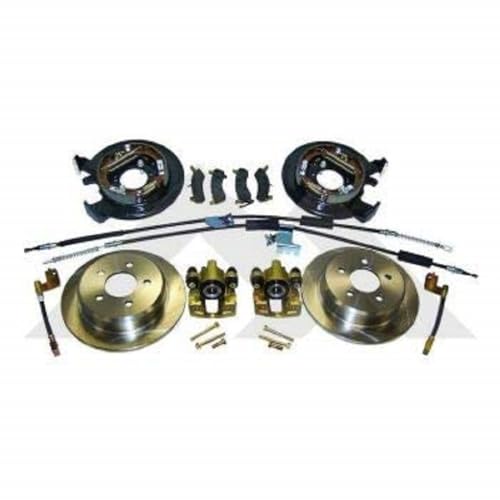
The Crown Automotive RT31006 kit is Jeep-focused, designed to improve braking on models that originally relied on drum systems. The listing highlights quality construction and a 12-month warranty, suggesting durability and long-term support. While product details are concise, the kit is positioned as a straightforward upgrade for Jeep applications where drum-to-disc conversion is desired without extensive aftermarket modification. Prospective buyers should verify model compatibility with their Jeep year and trim before purchasing.
Honda Fourtrax Front Disc Brake Conversion Kit

This front-disc conversion kit from M MATI targets Honda utility ATVs, offering a 12″ wheel-compatible upgrade for various models including Fourtrax 300, Rancher 350, Foreman 400/450, Rubicon 500, and Rincon 650. The listing notes important fitment constraints: it only fits wheels 12 inches and larger, and it does not support OEM aluminum wheels or include a wheel hub in the package. Prospective buyers should confirm their ATV’s wheel size and hub compatibility to ensure a proper fit before ordering.
Geinqiay Front Disc Brake Conversion Kit

The Geinqiay kit targets classic GM A-Body, F-Body and X-Body platforms spanning 1964–1974 era vehicles. It’s described as compatible with stock-style disc brake spindles and wheels 15 inches or larger. The kit includes spindles, 11″ vented rotors, calipers, brackets, pads, backing plates, hoses, and all necessary bearings, seals, and hardware. Consumers should review vehicle year, body style, and wheel compatibility to ensure a precise match for their restoration or performance upgrade project.
Inline Tube G-Body Rear Disc Brake Conversion Kit

The Inline Tube G-Body kit is tailored for 1978–1987 GM G-Body vehicles, delivering a complete rear-disc conversion with cross-drilled and slotted rotors for improved heat management and braking performance. The package includes calipers, cables, lines, hoses, brackets, shims, nuts, bolts, and hardware needed for installation. It’s essential to verify wheel clearance and mounting points on the specific G-Body model to prevent clearance issues and ensure optimal rotor-to-pad alignment.
Buying Guide
When selecting a disc brake conversion kit, buyers should weigh fitment, installation requirements, and long-term maintenance. The following considerations help compare options across the five selected products:
- Vehicle compatibility: Confirm whether a kit is rear, front, or whole-vehicle, and verify the exact axle or wheel size it supports. Some kits are designed for GM 10/12 bolt rear ends or 11″ rotors, while others target Jeep platforms or Honda ATVs. Mismatches can lead to improper braking balance or fitment issues.
- Wheel and hub compatibility: Many kits specify wheel diameter and bolt patterns (for example, 12″ wheels, 5×4.75″ or similar). Some do not include hub assemblies, requiring additional parts. Ensuring wheel clearance and hub compatibility avoids installation delays.
- Included hardware and components: Look for complete kits that include rotors, calipers, brackets, pads, hoses, and necessary seals. A comprehensive kit reduces the need for sourcing loose parts and simplifies installation.
- Brake balance and bias: Rear-only upgrades affect brake balance differently than front-only or complete conversions. Consider your vehicle’s weight, suspension, and braking needs to optimize pedal feel and stopping distance.
- ABS and modern brake system compatibility: Some older platforms may not integrate with ABS or may require additional sensors or modules. Confirm compatibility with your ABS system and electronic controls if applicable.
- Installation difficulty and tools: Kits vary in complexity. Some are near plug-and-play, while others require spindle modifications, drilling, or alignment work. Budget time for installation and have basic mechanical skills or professional help in mind.
- Rotor size and venting: Larger rotors typically provide better heat dissipation but may require more clearance. Vented rotors offer improved fade resistance under heavy use, which matters for individuals towing, off-roading, or long highway runs.
- Durability and warranty: Many brands advertise warranty terms (for example, Crown Automotive mentions a 12-month warranty). Consider suppliers with clear warranty coverage and readily available replacement parts.
- Cost and value: While premium kits deliver robust components, price often correlates with included hardware and ease of installation. Balance your budget with the desired level of performance and reliability.
- Maintenance implications: Disc brakes reduce drum maintenance but require attention to pad wear, rotor wear, and proper lubrication of pins and slides. Plan for periodic inspection as part of routine vehicle care.
Quick comparison at a glance
- Rear GM 10/12 bolt upgrade (Speedway Motors) offers a full kit with brackets, rotors, and calipers for a cost-effective solution in mid-size GM cars.
- Jeep-focused Crown RT31006 provides a straightforward drum-to-disc upgrade with emphasis on build quality and warranty.
- Honda ATV front-disc conversion from M MATI targets 12″ wheels, with explicit wheel and hub constraints to confirm before purchase.
- Geinqiay’s GM A-Body front-disc kit includes spindles and a comprehensive set of components for classic GM platforms.
- Inline Tube’s G-Body rear conversion emphasizes rotors and hardware for a classic GM rear-end upgrade, with a focus on compatibility with late-70s to mid-80s models.
Across these options, the best choice depends on the vehicle, wheel availability, and installation readiness. Users should systematically verify wheel size, axle type, and year-specific fitment before ordering. If uncertain, consult a qualified mechanic or automotive specialist to confirm compatibility and review installation steps.