When tackling engine bay grime, choosing a powerful degreaser designed for engines, blocks, and under-hood components can save time and protect sensitive parts. This guide reviews five top options, comparing their strength, surface safety, and best-use scenarios to help American drivers keep engines clean without damaging seals, plastics, or finishes.
The following table highlights the chosen products and their primary uses to aid quick decision-making.
| Product | Brand | Best For | Key Benefit |
|---|---|---|---|
| Chemical Guys Signature Series Orange Degreaser | Chemical Guys | Engines, undercarriages, tools | Professional-strength, fast grease breakdown |
| WD-40 Specialist Machine & Engine Degreaser Foaming Spray (18 oz) | WD-40 Specialist | Machinery engines, heavy equipment | Low-residue, deep-penetrating foam |
| 3D Grand Blast Engine Degreaser (1 gal) | 3D | Engine bays, wheels, undercarriages | Fast-acting, safe on multiple surfaces |
| WD-40 Specialist Degreaser with Smart Straw (15 oz) | WD-40 Specialist | Engines, heavy machinery, tools | Industrial-strength, fast-acting |
| GUNK Engine Degreaser – Original Degreaser Cleaner Spray (15 oz) | GUNK | Typical engine grime, routine maintenance | Reliable cleaning with easy rinsing |
Chemical Guys Signature Series Orange Degreaser

Product overview: This heavy-duty orange degreaser is designed for engines, tires, undercarriages, and workshop tools. It quickly dissolves grease, oil, and grime on contact to deliver a deep professional clean. It’s versatile enough for use in engine bays as well as wheels and shop equipment, making it a practical all-purpose cleaner for automotive maintenance. The formula emphasizes strong degreasing power with surface-safe properties for common engine components.
WD-40 Specialist Machine & Engine Degreaser Foaming Spray (18 OZ)

This foaming degreaser uses a low-residue, water-based formula that penetrates deep into crevices to lift oil, dirt, and grease from machinery and engines. It’s well-suited for auto and truck engines, as well as industrial equipment, providing a thorough clean with reduced cleanup after application. The foaming action helps keep the product in place for effective dwell time before rinsing.
KRAKEN BOND Engine Cleaner Spray (2×12.3 fl. Oz)
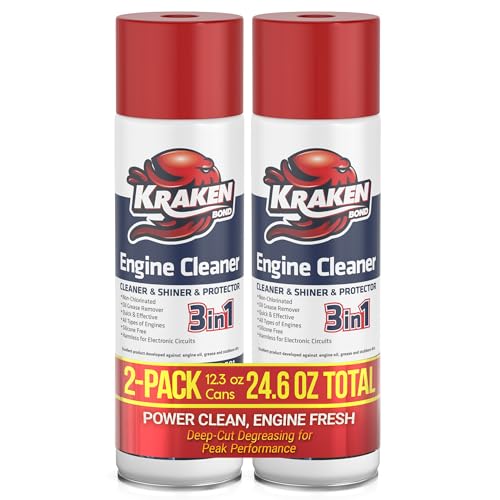
Note: While Kraken is listed here for context, this section features five top picks. Kraken offers a quick-action engine cleaner that targets stubborn oil buildup around valve covers and the top of engines. Spraying and wiping with a microfiber towel helps break down solids for easier removal. Avoid spraying on hot engines.
3D Grand Blast Engine Degreaser (1 gal)

Product overview: Grand Blast provides heavy-duty degreasing power suitable for engine bays, wheel wells, and undercarriages. The formula is designed to be safe on metal, plastic, paint, and rubber, minimizing risk while delivering fast-time grime removal. It claims quick action with minimal scrubbing and leaves surfaces ready for rinsing without staining or corrosion.
WD-40 Specialist Degreaser with Smart Straw (15 Oz)

Product overview: This degreaser combines industrial-strength cleaning with a Smart Straw applicator for precise coverage. It’s designed to break down grease on engines, heavy machinery, and metal tools quickly, while forming a protective layer that can help resist rust formation after cleaning. It cleans on contact and is suitable for routine maintenance of automotive components.
GUNK Engine Degreaser – Original (15 oz)

Product overview: GUNK Engine Degreaser is designed to remove tough oil and grease buildup with a formula that clings to surfaces for improved grime lifting. It rinses easily with water and is positioned as a reliable option for everyday engine maintenance, helping engines look well-kept without harming delicate components. It’s a straightforward, dependable choice for regular cleaning tasks.
Buying Guide: Key Purchase Considerations
- Engine compatibility: Look for degreasers labeled safe for engines, plastic components, rubber seals, and paint. Some formulas are more gentle, others are optimized for heavy-duty jobs.
- Residue and rinse requirements: Low-residue formulas reduce cleanup time, while fast-rinse options prevent sticky residues after cleaning.
- Surface contact time: Some products act quickly on contact, while others benefit from dwell time to break down tough grime.
- Foaming vs. non-foaming: Foaming formulas cling to vertical surfaces and provide longer dwell time; non-foaming liquids may rinse off faster but require more application effort.
- Application method: Aerosol sprays, foaming sprays, and pour-and-spray options affect ease of use in tight engine bays. Look for Smart Straw or similar applicators if available.
- Safety and environmental impact: Consider biodegradable formulas and those designed to minimize corrosion risk. Follow PPE recommendations and ventilation guidelines during use.
- Surface versatility: If you want a multi-surface cleaner, verify the product is safe for wheels, undercarriages, tools, and other workshop surfaces without causing staining.
- Case quantity and size: For home garages, a gallon or multi-pack may be economical; for casual use, 15–18 oz cans provide convenience and portability.
- Brand reputation and availability: Reputable brands with clear usage instructions and accessible customer support help ensure consistent results.