Choosing the right deep cycle battery means balancing capacity, weight, cycle life, and maintenance. For RVs, boats, off‑grid cabins, and trolling motors, a dependable deep cycle battery keeps essential systems powered through long days and chilly nights. This guide highlights five top-rated models that emphasize safety, durability, and steady discharge performance across AGM and LiFePO4 chemistries. Each option is suitable for Group 24 or 31 trays and works with standard inverters and solar setups. Use this overview to compare capacity, self-discharge, charging needs, and weight so you can choose a battery that fits your power needs and budget.
| Product | Brand | Capacity | Chemistry | Best Use |
|---|---|---|---|---|
| Renogy Deep Cycle AGM 12V 100Ah Battery | Renogy | 100Ah | AGM | RV / Off‑Grid / Marine |
| WEIZE Deep Cycle AGM 12V 100Ah Battery | WEIZE | 100Ah | AGM | RV / Solar / Marine |
| Interstate Batteries Marine Deep Cycle 12V 100Ah | Interstate Batteries | 100Ah | AGM | Marine / Trolling Motor |
| GRNOE 2‑Pack 12V 100Ah LiFePO4 | GRNOE | 100Ah each | LiFePO4 | RV / Off‑Grid / Lightweight Install |
| EBL Platinum AGM 12V 60Ah | EBL | 60Ah | AGM | Vehicle / Small Boat / Backup Power |
Renogy Deep Cycle AGM 12V 100Ah Battery

Renogy’s Deep Cycle AGM battery is designed for high safety and reliable performance in a variety of power setups. The AGM design minimizes maintenance and eliminates acid leakage concerns, which is valuable for RVs, boats, and off‑grid cabins. This model is compatible with series connections (no limit) and can be paralleled up to four units, enabling scalable capacity for larger systems or extended outings. The 100Ah rating matches common requirements for mid‑size inverters and supplemental solar charging, delivering steady power for lighting, refrigeration, fans, and basic appliances. The internal chemistry emphasizes stability, providing a predictable discharge curve and lower troubleshooting needs compared with some other chemistries. With a modest self‑discharge rate, it performs well when stored between trips.
In practice, this battery stacks well with standard Group 24 trays used in many RVs and boats. Its sealed, maintenance‑free construction supports flexible mounting and safe operation in confined spaces. The robust build suits mobile environments where vibration and movement are common, such as on boats or during weekend road trips. For owners prioritizing safety, reliability, and straightforward maintenance, the Renogy 100Ah AGM battery remains a solid core option for backup power or daily operation. Pairing it with a compatible inverter and a multi‑stage charger helps maximize lifespan and performance.
WEIZE Deep Cycle AGM 12V 100Ah Battery
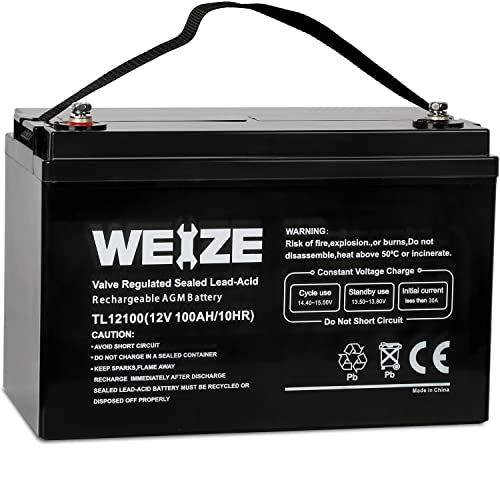
WEIZE’s 12V 100Ah AGM battery is a maintenance‑free, sealed lead‑acid option engineered to reduce leakage risk and simplify installation. Its AGM design minimizes self‑discharge, helping you hold a charge during longer storage periods. The battery supports a fairly broad operating envelope: charging temperatures from 14°F (-10°C) to 122°F (50°C) and discharging temperatures from 5°F (-15°C) to 122°F (50°C). A robust 1100A max discharge current provides a strong burst capability for inverters and appliances that demand brief surges. Its relatively compact dimensions and standard terminal layout make it a practical fit for RVs, solar setups, trolling motors, and marine applications.
With a longer expected lifespan relative to some flooded lead‑acid models, WEIZE emphasizes reliable performance under typical wear and tear, including frequent vibration and camping‑season usage. To maximize life, avoid extended periods at fully discharged states and keep the battery within its recommended temperature range. The 100Ah rating is well suited for mid‑size rigs and off‑grid configurations where a balance of weight, space, and power is crucial. In practice, this battery delivers steady, predictable power for lights, pumps, and essential electronics.
Interstate Batteries Marine Deep Cycle 12V 100Ah

This Interstate Marine Deep Cycle battery targets long‑lasting, reliable power for boats and other marine platforms. The design emphasizes deep‑cycle capacity with thick plates that support repeated discharges while maintaining performance over time. The claims highlight an extended service life compared with conventional flooded batteries and an overall emphasis on rugged, marine‑grade construction. While it is rated for deep discharge and compatibility with trolling motors and boat electronics, it remains an AGM model that requires minimal maintenance and supports steady, continuous use in saltwater or freshwater environments. The emphasis on “not for automotive replacement” keeps expectations aligned with marine needs.
In practice, this model appeals to boaters seeking a robust, ready‑to‑use option that can power electronics, lighting, depth finders, and trolling motors during extended outings. Its thick‑plate design helps resist performance losses after repeated draining and recharging cycles, contributing to a longer life for the battery in demanding environments. For customers prioritizing marine durability and a brand with broad service support, the Interstate 100Ah AGM is a practical fit. When pairing with solar or wind charging, ensure compatible charging profiles to optimize cycle life.
GRNOE 2‑Pack 12V 100Ah LiFePO4

These two LiFePO4 batteries from GRNOE offer a high‑cycle, lightweight alternative to traditional lead‑acid options. Each battery provides 100Ah with an integrated 100A BMS, delivering protection from overcharge, over‑discharge, overcurrent, short circuits, and temperature extremes. With about 15,000 deep cycles at 60% DOD, LiFePO4 cells deliver dramatically longer life than many lead‑acid models, making them attractive for long‑term off‑grid installations, RVs, and mobile power systems. At roughly 21.9 pounds apiece, these packs are significantly lighter than GE/lead‑acid equivalents and easier to handle in tight spaces. They are designed to fit standard Group 24 trays and are ideal for modular, upgradeable power setups.
In practice, the 2‑pack design supports extended outages with critical loads, such as refrigeration, lighting, communications gear, and devices with varying power demands. The LiFePO4 chemistry provides stable voltage during discharge and a consistent performance profile across temperatures, improving inverter efficiency and runtime. While upfront costs are higher than some AGM options, the long cycle life and significant weight savings can justify the investment for RVs, boats, and off‑grid cabins where frequent battery replacement is costly. Ensure your charger and BMS are LiFePO4‑appropriate for optimal results.
EBL Platinum AGM Battery BCI Group 47R‑12V 60Ah

The EBL EB‑AGM H5 combines strong starting power with solid deep‑cycle capability. Rated at 660A CCA and 792A CA, it delivers reliable ignition in extreme temperatures while maintaining stable power output through its AGM design. With an impressive 100‑minute reserve capacity (RC), this battery provides a valuable backup for essential electronics in the event of alternator issues or limited charging opportunities. Maintenance‑free and valve‑regulated, the AGM construction reduces leaks and corrosion, even when mounted in awkward spots. It suits cars, boats, RVs, and other off‑grid applications where dependable starting power plus some deep discharge capacity matters.
In practical terms, the EBL 60Ah battery offers a compact, versatile option for smaller power systems or auxiliary power packs on vehicles and watercraft. It’s well‑suited for users who need reliable cranking alongside occasional deep cycling without frequent maintenance. For longer off‑grid use, pairing with appropriate solar charging and a compatible inverter helps maximize cycle life. As with all AGM packs, monitor charging voltages and temperatures to preserve performance and longevity.
Buying Guide
When choosing a deep cycle battery, start with your power demands and space constraints. Consider two core chemistries—AGM lead‑acid and LiFePO4—each with distinct trade‑offs in weight, lifespan, and price. LiFePO4 cells typically offer far longer cycle life, linear voltage during discharge, and significantly lower maintenance, but at a higher upfront cost. AGM batteries provide strong deep‑cycle capability with broad availability and weight that remains manageable for most trailers, boats, and small off‑grid systems.
Key purchase considerations include capacity and depth of discharge (DOD). A higher Ah rating increases usable energy but adds weight and cost. LiFePO4 systems often allow deeper DOD (commonly 80–100%), translating to more usable energy per cycle, while AGM lead‑acid systems are frequently recommended at 50–80% DOD to maximize life. Temperature range and charging strategy are essential; LiFePO4 tolerates wide temperatures but requires a compatible BMS and charger, whereas AGM requires proper charging voltages to avoid sulfation and shorten life.
Physical fit matters too. Check the battery size, tray compatibility (Group 24 vs Group 31, etc.), terminal orientation, and mounting space. For marine or RV use, ensure the battery is sealed, vibration‑resistant, and supported by a warranty. Inverter compatibility matters as well; large inverters may require higher peak currents and adequate cable sizing. A reliable BMS is crucial for LiFePO4 packs to protect cells from overcharge, over-discharge, and temperature extremes.
Weight and handling are practical considerations. LiFePO4 packs are substantially lighter for the same capacity, improving installation in tight compartments or overhead installations. AGM models are typically heavier but can be more budget‑friendly upfront, with strong performance in many off‑grid and marine scenarios. Finally, assess warranty terms and the brand’s service network. A longer warranty and accessible customer support can reduce total ownership costs and provide peace of mind for critical power needs.