Smart tire pressure monitoring is a foundational safety upgrade for RVs, trailers, trucks, and SUVs. Aftermarket TPMS options bring real-time pressure and temperature data, audible and visual alerts, and flexible power options to fit busy road schedules. The five selections below cover solar-charged models, plug-in designs, and systems with six to ten sensors for multi-axle trailers or large RVs. Each option is evaluated on sensor count, range, display quality, installation ease, and reliability to help you pick a system that matches your vehicle and driving needs.
| Product | Brand | Sensors | PSI Range | Display | Power |
|---|---|---|---|---|---|
| Tymate TM2 RV TPMS | Tymate | 4 | 0-87 PSI | Color LCD | Solar + USB |
| Tymate TM7 TPMS | Tymate | 4 | 0-87 PSI | Color LCD | Cigarette lighter + USB |
| LETOURWM RV TPMS | LETOURWM | 6 | 0-144 PSI | LCD with Auto Brightness | Solar + USB |
| Flydew 6-Wheel RV TPMS | Flydew | 6 | 0-144 PSI | LCD | Solar + USB-C |
| GUTA Trailer TPMS | GUTA | 10 | 0-188 PSI | Large Screen | Power not specified |
TM2 RV TPMS With Solar Charge

The Tymate TM2 combines four external sensors with a color LCD display and solar charging, designed for RVs, trailers, trucks, and SUVs. It offers six alarm modes, including fast leak detection, high/low pressure alerts, high temperature warnings, and sensor health notifications. When paired, the system uses the current tire pressure as the reference point, enabling alarm thresholds within +25% and -15% of that reference. The IP67-rated sensors are pre-labeled and factory-paired to the monitor, removing the need for per-sensor setup. Sensor batteries provide up to six months of life, with an overall system lifespan that can reach two years with normal use. Solar charging ensures continuous power, with USB charging as a backup when sunlight is limited.
Installation is straightforward for most RV and trailer configurations, and the color LCD display delivers clear, legible data even in bright daylight. The TM2 is well-suited for drivers who want a balance of sensor count, reliability, and autonomous power management, without sacrificing monitoring quality on long trips.
TM7 Wireless TPMS With Color LCD

The Tymate TM7 TPMS provides accurate real-time monitoring with six alarm modes, including high/low pressure, fast leakage, high temperature, sensor low battery, and sensor signal loss. It reads tire pressure and temperature with precision (approximately ±1.5 PSI and ±3°F) and can display units in Celsius or Fahrenheit and switch between BAR and PSI. The unit powers directly from the vehicle’s cigarette lighter socket and supports two USB outlets, enabling device charging for drivers who need to stay connected on the road. Its color LCD with adjustable backlight ensures readability in varied lighting, making it a strong option for retirees, fleets, and DIY enthusiasts alike.
Designed for older vehicles or DIY setups, TM7 emphasizes quick, non-wiring installation. This model is ideal for drivers seeking a compact monitor that combines easy mounting, real-time data, and essential alerts without a full professional install.
LETOURWM RV TPMS With 6 Sensors

The LETOURWM TPMS includes six external sensors and a color LCD display with auto brightness and voice alerts. It covers a wide range, from 0 to 144 PSI, making it suitable for RVs, trailers, and larger trucks. The system supports dual charging via solar power and USB, helping to maintain operation during long trips or in poor sunlight. With six alarm modes—high/low pressure, high temperature, rapid leak, sensor failure, and low battery—the LETOURWM TPMS provides robust safety coverage. The automatic reference pressure setup simplifies configuration and reduces setup time after sensor installation.
For road crews and frequent travelers who push their rigs to the limit, the six-sensor kit offers expanded tire monitoring without sacrificing display clarity or alert responsiveness. The solar option enhances reliability in remote locations where access to electrical outlets is limited.
Flydew 6-Wheel RV TPMS
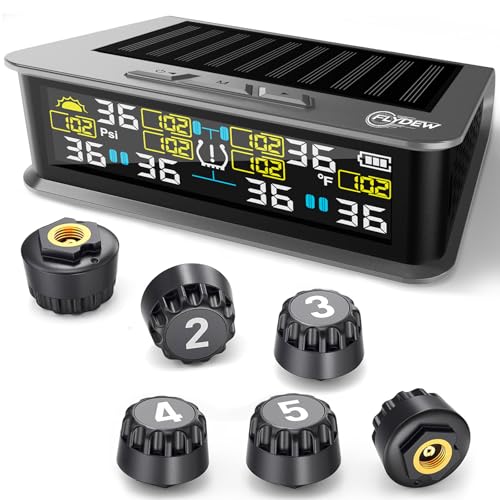
The Flydew 6-Wheel RV TPMS is built for multi-axle configurations with six external sensors and six alarm modes. It monitors real-time pressure and temperature across up to 0-144 PSI, providing rapid feedback for heavy loads and long-haul towing. The system supports dual charging through solar power and USB-C, helping to maintain continuous operation during extended trips. An LCD display keeps tire data readable, with updates occurring approximately every six seconds to alert drivers of any deviations or leaks.
As a high-capacity option, Flydew is well suited for dually trucks and large RVs where multiple tires require constant supervision. The combination of fast data refresh, robust alarm coverage, and flexible charging makes it a practical choice for professional or weekend travelers who demand dependable performance from their TPMS.
GUTA Trailer TPMS With 10 Sensors

The GUTA Trailer TPMS offers extensive tire coverage with up to 10 sensors and a large-screen display that can show data for multiple tires on a single page. It supports monitoring of pressures up to 188 PSI and temperatures up to 185°F, making it suitable for large trailers and motorhomes. Its alert system covers high/low pressure, high temperature, fast leaks, missing sensor signals, and low sensor battery. The system can automatically switch between front and rear tire data and can handle up to 34 tires when paired with the optional components. An additional signal booster expands range for distant or obstructed installations.
GUTA’s setup emphasizes expandability and fleet-like monitoring. Its multi-axle capability is ideal for heavy-duty trailers and campers that require wide tire oversight, while the alerting network supports proactive maintenance and safer long-distance travel.
Buying Guide
How Many Tires Do You Need Monitored?
Consider your vehicle’s tire count: four for most cars and light trucks, six for many large RVs or dual-rear-axle setups, and up to ten or more for multi-axle trailers. Systems with more sensors (6, 8, or 10) simplify full coverage without reconfiguring the monitor. If you regularly tow or carry heavy loads, a 6- or 10-sensor setup may offer important visibility across all tires and improve safety margins on the road.
Power Options And Installation
Solar charging provides remote reliability, while USB or cigarette-lighter power ensures operation inside garages or when sunlight is scarce. Some models pair sensors at the factory and require minimal setup, while others allow you to customize thresholds and sensor placement. For quick upgrades on older vehicles, plug-in TPMS units are particularly attractive for fast installation and immediate use without rewiring.
Display Quality And Alarm Customization
Color LCD displays with adjustable backlight improve readability in bright daytime and low-light conditions. Voice alerts and auto-brightness features help drivers stay informed without taking their eyes off the road. A broader set of alarm modes (high/low pressure, high temperature, rapid leaks, sensor disconnects, and low battery) provides more comprehensive safety coverage, especially for caravans and long-haul trips.
Sensor Durability And Battery Life
IP ratings (such as IP67) indicate waterproof and dustproof durability for sensors, which is important for exposed environments. Battery life (often 6–24 months for CR1632-powered sensors) reduces maintenance frequency, and some systems offer replaceable batteries or long-life designs to minimize replacements on the road.
Expandability And Vehicle Compatibility
Large vehicles and multi-axle trailers benefit from systems that support many sensors and easy expansion. Some TPMS options are especially suitable for RVs and trailers, while others may be better for factory-equipped or aftermarket light trucks. Review the maximum tire count and whether the system supports adding boosters or signal extenders to improve range in cluttered or remote installations.
Data Units, Climate, And Reliability
Most TPMS units provide PSI and temperature readings; some offer BAR or °C/°F display options. Be mindful of climate conditions where you drive—extreme temperatures can affect battery life and sensor performance. Look for IP ratings, manufacturer-reported sensor life, and whether the kit includes pre-labeled, factory-paired sensors for straightforward setup.