Engine oil leaks can undermine performance and raise maintenance costs. The following additives are commonly used to seal seals, reduce consumption, and quiet leaks across a range of gasoline engines. This guide highlights five popular options, their intended uses, and what to consider when choosing an additive to stop engine oil leaks.
| Product | Brand | Suggested Use |
|---|---|---|
| Lucas Oil 10278 Engine Oil Stop Leak | Lucas Oil | Seal renewal and oil pressure maintenance |
| XADO ATOMEX Oil Additive Stop Leak | XADO | Elasticity restoration for seals and gaskets |
| Bar’s Leaks 1000 High Mileage Engine Repair | Bar’s Leaks | Stops leaks; improves compression and performance |
| Bar’s Leaks OS-1 Oil Seal Engine Oil Burning and Leak Repair | Bar’s Leaks | Seals main seals and renews valve seals |
| Lucas Oil 11100 Engine Oil Stop Leak | Lucas Oil | Conditions seals and reduces wear |
Lucas Oil 10278 Engine Oil Stop Leak — 1 Quart

The Lucas Oil 10278 stop-leak formula is designed to restore worn seals and reduce oil consumption. It is compatible with petroleum, semi-synthetic, and full synthetic oils, and aims to raise oil pressure while lowering engine noise. The product emphasizes a safe approach to renew seals without introducing corrosive agents. This option is marketed for broad engine compatibility and ease of use in everyday vehicles.
XADO ATOMEX Oil Additive Stop Leak

XADO ATOMEX is positioned to restore the elasticity of rubber seals and gaskets, helping to stop engine oil leaks. The formula targets multiple engine types, including motorcycles, and emphasizes sealing performance, rejuvenation of seals, and extended engine life. It is presented as a comprehensive solution for older engines facing wear-related leaks and general seal degradation.
Bar’s Leaks 1000 High Mileage Engine Repair
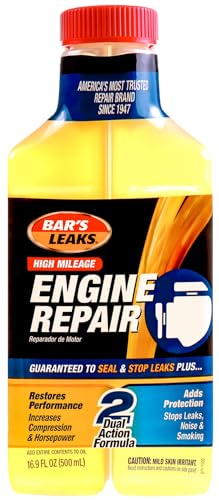
This product combines additives intended to repair common oil-related issues while boosting compression and horsepower. It is designed to reduce oil consumption and engine noise, and to support worn components such as rings and bearings. It targets leaks and misbehavior in engines with higher mileage, offering a potentially economical preventive option before more costly repairs.
Bar’s Leaks OS-1 Oil Seal Engine Oil Burning and Leak Repair

Bar’s Leaks OS-1 focuses on sealing main seals and renewing worn valve seals and guides. It is compatible with a wide range of gasoline and diesel engines, including turbocharged and hybrid setups. The product advertises stopping oil burning and blue exhaust smoke, making it suitable for engines that exhibit both leaks and burning symptoms in varied cylinder configurations.
Lucas Oil 11100 Engine Oil Stop Leak — Top Off Additive

This Lucas Oil product emphasizes long-lasting seal conditioning to prevent leaks and reduce friction. It focuses on preserving seals and o-rings, potentially extending engine life by minimizing wear. The formulation is presented as a top-off additive suitable for maintaining existing seals and preventing new leaks during normal operation.
Buying Guide: Key Considerations For Choosing An Oil-Leak Stop Additive
- Engine type and oil compatibility: Check whether the additive is compatible with your oil type (petroleum, semi-synthetic, full synthetic) and your engine’s design. Some products explicitly support a wide range of oil chemistries, while others are targeted to high-mileage engines.
- Seal material and condition: Seal restoration approaches vary. Elasticity restoration formulas are geared toward gasket seals, while seal sealers aim to fill small gaps. If seals are hardened or severely worn, a product with elasticity restoration may be less effective than a dedicated seal sealer.
- Burning oil vs. leaks: If your vehicle leaks oil but also burns oil, consider formulations that address both issues (smoke control, seal restoration, and burning prevention). Some products advertise emissions benefits along with leak sealing.
- Engine age and mileage: High-mileage engines often benefit from products designed to restore elasticity and protect worn seals. For newer engines, choose lighter formulations that reduce friction without over-restoring seals.
- Maintenance strategy: Use additives as part of a broader maintenance plan, including regular oil changes, filter replacement, and addressing any mechanical wear. Relying solely on additives may delay necessary repairs in some cases.
- Availability and compatibility with warranties: Some manufacturers caution against using additives if your vehicle is under warranty or if it requires specific oil formulations. Always verify compatibility with your vehicle’s warranty terms.
- Application guidance: Follow dosing instructions carefully. Overuse can alter oil viscosity or lead to unintended deposits, while underuse might yield limited benefits.
Choosing an additive to stop engine oil leaks involves balancing seal condition, engine design, and the root cause of the leak. The selections above cover a range of approaches—seal conditioning, elasticity restoration, and leakage sealing—allowing drivers to pick a solution that aligns with their vehicle’s needs and maintenance goals.